Best Place to Advertise as an Electrician in the UK (2026)
The short answer: there is no single best advertising channel for every electrician. The right mix depends on the work offered, real coverage, whether demand is urgent or planned, response capacity, and qualified-enquiry cost. An eligible Google Business Profile and useful service pages can support a local-search foundation. Paid search can add exposure sooner but needs continuing spend and control. Directories, referrals and social activity each have different ownership, predictability and response trade-offs.
Before buying exposure, define the services wanted, excluded work, real coverage, response capacity and stages from enquiry to completed work. The marketing page for electrical businesses explains how LokAgent approaches those foundations without supplying leads or promising job volume.
Start with the service and the customer's situation
“Electrician” covers very different customer decisions. A person with a loss of power may act differently from a landlord arranging an inspection, a homeowner considering an EV charger or a facilities manager comparing maintenance providers. A channel that suits immediate domestic work may be a poor fit for a longer commercial buying process.
Group genuine services by customer situation:
- Urgent faults and call-outs that the business is actually staffed to handle.
- Planned domestic work such as rewires, consumer-unit work or installation projects.
- Inspection and compliance-related services for landlords or businesses.
- Specialist work such as EV charging, renewables or commercial maintenance, but only when genuinely offered.
For each group, state relevant qualifications, service boundaries, availability, useful project evidence and contact expectations. Do not claim emergency availability merely because a phone or automated message can operate outside working hours.
Electrician advertising channel comparison
The useful question is not “Which channel is best?” It is “Which channel reaches the right customer, under terms we understand, while we have the capacity to respond?”
| Channel | Likely time to visibility | Payment model to check | Service fit | Attribution | Asset retained | Response need |
|---|---|---|---|---|---|---|
| Eligible local search through Google Business Profile | Depends on eligibility, accuracy, relevance, distance and prominence | Profile use itself is not an advertising fee; management work may have a cost | Strong where customers need a real local or service-area business and the profile accurately represents operations | Profile interactions need authorised owner access; website actions need separate tracking | Accurate profile history and connected website relationship | Keep facts current and respond through the channels the business genuinely monitors |
| Organic service pages | Usually a longer-term publishing and technical programme | Website, content and maintenance costs | Strong for specific services, customer questions and evidence that can be explained in depth | Search Console plus privacy-safe call and form tracking | Website pages, content and learning remain under the owner's control | Maintain pages, technical access, evidence and contact paths |
| Paid search | Visibility can begin after setup and platform approval, but outcomes vary | Media spend plus any management, landing-page and tracking costs | Useful when keywords, service scope, location and exclusions can be controlled | Advertising platform, landing-page and qualified-enquiry records | Account learning and landing pages are retained only if ownership is explicit | Active budget, query, landing-page and response management |
| Directory or marketplace | Depends on provider acceptance, local demand and listing position | Membership, listing or contact terms vary by provider | Can expose the business to customers already using that provider | Use provider records and the business's own enquiry stages | Listing history is governed by provider terms; customer learning should also be retained internally | Check whether opportunities are shared and respond within a truthful operating process |
| Referral and partnership | Irregular rather than campaign-driven | Relationship or referral terms where applicable | Strong when the referrer understands the work and customer fit | Record the referrer, service, qualification decision and outcome | Customer relationship and referral learning | Set expectations with both referrer and customer |
| Social and community activity | Builds with consistent relevant participation | Content time, production and optional promotion | Useful for project evidence, education, recruitment, remarketing and local relationships | Platform and website referral tracking | Content may be reusable, subject to platform and customer permissions | Maintain replies and never publish customer or site details without permission |
No row is universally superior. Use this matrix to shortlist a test, not to declare a permanent winner.
Google Business Profile and local discovery
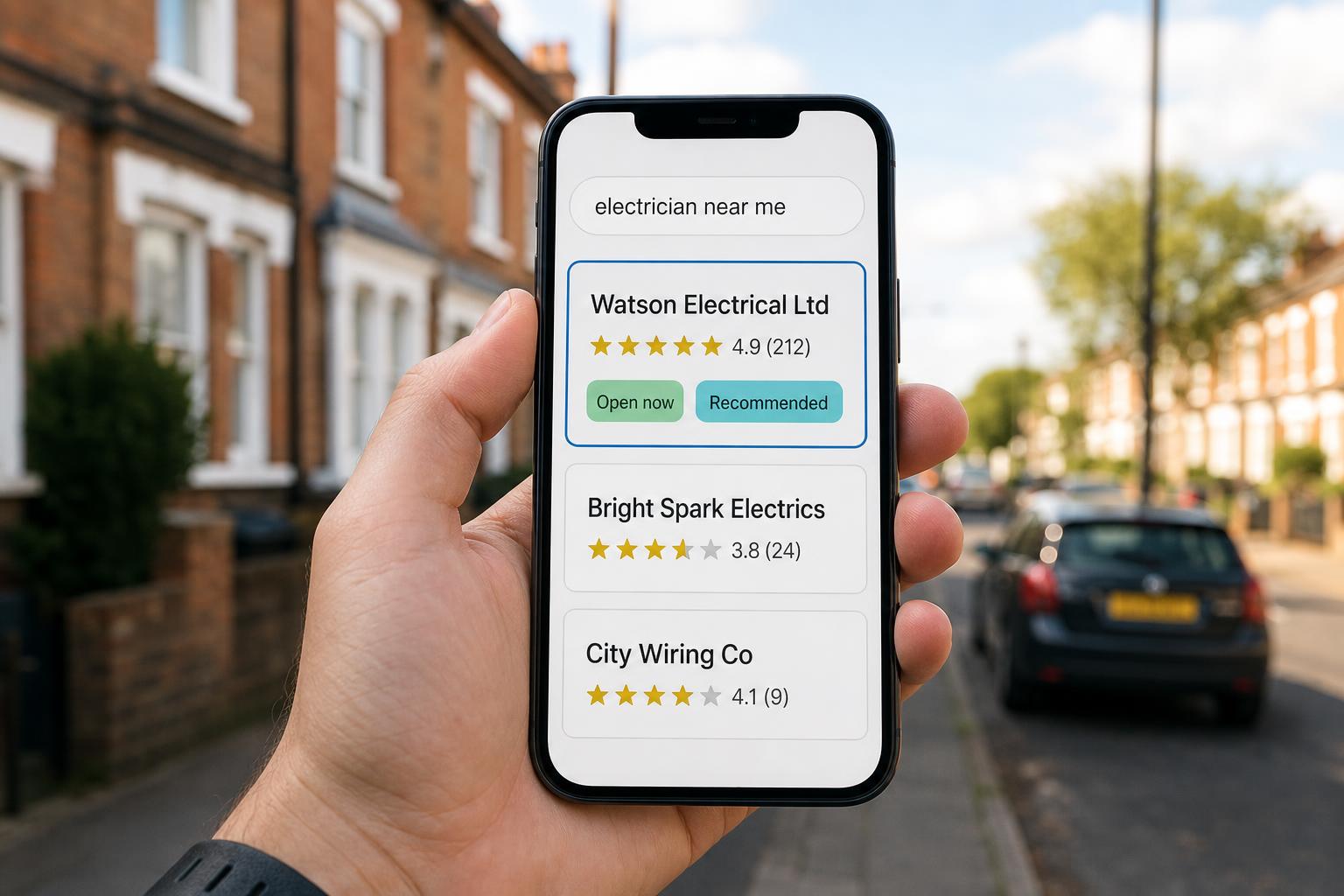
A Business Profile is relevant only when the electrical business meets Google's in-person customer-contact requirement. A service-area electrician may be eligible when it travels to customers from a real operating base. An online-only business or lead-generation operation is not eligible. Do not create a virtual address, broad service area or invented opening hours to gain local visibility.
For an eligible business, the profile should reflect the real name, category, services, contact details, hours or appointment model, and areas genuinely served in person. The connected website should describe the same operation. Google's published local-ranking framework refers to relevance, distance and prominence. It does not provide a formula that makes one field, review count, photo target or posting cadence a guaranteed ranking lever.
Use the public Google Business Profile audit to understand what public information can be observed and which owner-only fields still need authorised access. An audit can identify inconsistencies and evidence gaps, but it cannot guarantee placement.
Organic search and useful service pages
Organic search is an owned-content route. Build separate pages when services answer materially different customer questions, not simply to repeat a town name. A useful electrical service page can explain:
- What the service includes and excludes.
- Which customers or property types it suits.
- Relevant qualifications or evidence that can be verified and maintained.
- Real geographic coverage and availability.
- What information to provide when making an enquiry.
- What happens after contact and who handles technical decisions.
Good technical foundations matter too: crawlable initial content, one self-canonical URL, descriptive titles, useful internal links, accurate structured data and a working contact path. LokAgent's local SEO service reviews these foundations and prioritises improvements. It does not promise a position or a volume of electrical work.
Paid search
Paid search may suit a business that wants controlled exposure for a defined service and can monitor the campaign. It should not be switched on with one generic landing page and an undefined idea of a “lead.” Ask:
- Who owns the advertising account, landing pages, conversion data and call records?
- Is media spend separate from management fees?
- Which services, locations and times are included or excluded?
- What search terms actually triggered the advertisement?
- What makes an enquiry qualified for this electrical business?
- Can the team respond without making unsafe or inaccurate promises?
- How are spam, employment enquiries, supplier calls and out-of-scope work excluded from reporting?
Measure qualified customer enquiries and downstream business stages, not clicks alone. Paid visibility stops when the campaign stops, but the business should still retain its approved landing pages, measurement design and account learning when the contract says it owns them.
Directories and marketplaces
Directories and marketplaces can be useful when their audience, local coverage and terms fit the business. They are not one category with one price or one lead model. Before joining, inspect the provider's current terms and ask whether contacts are exclusive, shared or simply listing exposure.
Check who owns the customer relationship, how cancellations work, whether a tracked number is used, what evidence is required, and whether the provider can change where the listing appears. Record contact quality in the same internal system used for other channels. A high contact count is not useful if the work is outside the business's services, area, availability or commercial threshold.
Where AI-assisted search fits
AI-assisted search is another discovery surface, not a guaranteed replacement for the channels above. Clear public service information, crawlable pages, consistent identity and maintainable sources can make a business easier for search systems to understand. No schema type, crawler permission or content format guarantees that an electrician will be mentioned or cited.
The practical steps and access limitations are explained in how to show up in ChatGPT search results. Treat any AI visibility check as a dated observation of a defined query, not proof of coverage across every assistant, user, location or date.
Choose the first test
Use a short decision process:
- Name the service, customer and area the test should reach.
- Define a qualified customer enquiry and confirm response capacity.
- Record the full operating cost and ownership of accounts, pages and data.
- Choose a review point based on enough real evidence, not a promised universal timeframe.
- Compare enquiries, quotes and completed work only where those stages are recorded consistently.
If the business is already at capacity, the answer may be to narrow or pause acquisition rather than buy more exposure. Improve service fit, availability messages and measurement before expanding again.
LokAgent can review the connected website, available public local-search signals and one documented Google-grounded AI query, then prioritise practical actions. It does not supply shared or exclusive electrical enquiries, change a Business Profile automatically or guarantee jobs.
Frequently asked questions
What is the best place to advertise as an electrician in the UK?
There is no universal best place. An eligible Business Profile and useful service pages can build owned local visibility. Paid search can add controlled exposure with continuing spend. Directories provide access under provider-specific terms. Referrals transfer trust but arrive irregularly. Choose according to service type, area, capacity, ownership and measured qualified-enquiry cost.
Does an electrician need a Google Business Profile?
No. It is useful only when the business is eligible and the profile accurately reflects real in-person operations. Online-only and lead-generation businesses are not eligible. An electrician travelling to customers may qualify as a service-area business when it follows Google's rules.
Is paid search worth using for electrical services?
It can be when the business has a defined service, controlled location and schedule, a relevant landing page, clear exclusions, accurate tracking and someone able to respond. Review actual qualified enquiries and downstream work rather than assuming traffic or calls are automatically valuable.
Are trade directories worth joining?
They may be, depending on the current audience, local coverage, membership or contact model, sharing rules, cancellation terms and work quality. Read the provider's current terms and compare qualified customer outcomes with the full operating cost.
What should an electrician count as a qualified customer enquiry?
The definition belongs to the electrical business. It might require a genuine customer, an offered service, a workable location, sufficient information and a feasible response path. Keep employment, supplier, spam and out-of-scope contacts separate. Qualification is not the same as a booked or completed job.
Does LokAgent supply electrical work leads?
No. LokAgent does not sell or guarantee shared, exclusive or other electrical work leads. It reviews owned website and public search foundations and can support configured follow-up for genuine enquiries that already reach the business.
Source notes: Google documents Business Profile eligibility, how a business should represent itself, and the high-level local ranking factors of relevance, distance and prominence. Google's AI features guidance explains that normal search eligibility and useful indexed content are the foundation for those surfaces, without guaranteeing inclusion. No external prices, performance statistics or universal channel outcomes are used in this article.