Call Answering Service for UK Tradespeople (2026 Guide)

The short answer: choose a human answering service when callers need a live conversation, judgement within an approved script or a warm transfer. Use voicemail when call volume is low, the work can wait and customers are willing to leave enough detail. Use automated missed-call SMS when the immediate need is to acknowledge a missed call, collect a few structured facts and hand the conversation back to a responsible person. None of these options is best for every trade, and automation should not diagnose technical work, invent availability or promise that an enquiry will become a job.
The right choice depends on when calls arrive, what callers need, the service risk, the information required, the response owner and the total operating cost. Start by reviewing a sample of your own call outcomes rather than relying on generic missed-call or conversion statistics.
What a call answering service does
A call answering service receives calls that the trade business cannot or does not answer directly. The service may use receptionists, an automated voice system or a mixture of routing and human support. Its permitted actions should be explicit. Examples include taking a message, checking an approved service area, transferring a call, recording an appointment request or escalating a defined situation to an on-call person.
That is different from missed-call SMS. A text-back workflow does not answer the original call. After a qualifying missed call, it can send a message that identifies the business, acknowledges the call and asks for limited information. The business still needs a person or approved process to monitor replies and decide what happens next.
Voicemail is the simplest alternative. It gives the caller a place to leave a message without involving a supplier or starting a text conversation. Its success depends on the greeting, caller willingness, message quality and the business's callback process.
Human answering, voicemail and missed-call SMS compared
| Option | Caller experience | Context captured | Judgement and escalation | Cost basis to inspect | Main dependency | Strongest fit |
|---|---|---|---|---|---|---|
| Human call answering | A person answers using the agreed business greeting and script | Can ask approved follow-up questions and clarify an answer | Human judgement is available within training and authority limits; technical or commercial decisions still need the trade | Package, call volume, call duration, transfers, out-of-hours coverage and setup terms | Accurate scripts, current rotas, training and quality review | Calls needing conversation, reassurance, live transfer or careful exception handling |
| Voicemail | The caller hears a recorded greeting and chooses whether to leave a message | Limited to what the caller volunteers | No live judgement; the business reviews the recording later | Telephony, mailbox and staff callback time | Clear greeting, working mailbox, notifications and owned callback process | Lower-volume or non-urgent calls where delayed response is acceptable |
| Automated missed-call SMS | A qualifying missed call triggers a written acknowledgement and limited questions | Can collect structured facts chosen by the business | No technical judgement unless a verified human takes over; replies need monitoring and escalation | Messaging, number or forwarding, workflow, support and integration terms | Correct trigger, delivery, consent controls, reply ownership and safe handover | Acknowledgement and basic information capture when a call was not answered |
Do not compare headline prices alone. Check inclusions, extra charges, number presentation, record ownership, retention and routing-failure support against the current provider terms.
When human answering is the better fit
Human answering is useful when callers need a real conversation rather than a short acknowledgement. A receptionist can clarify a name, repeat an address, check an approved rota or transfer a caller to the responsible person. It can also be easier to manage unusual situations that fall outside a narrow automated flow.
The receptionist should not be presented as an electrician, plumber, engineer or surveyor unless that is genuinely true and authorised. Define what the service can say about prices, coverage, availability, emergencies, appointments and technical questions. Use clear escalation rules for safety concerns, complaints, vulnerable callers, existing customers and anything outside the script.
Review sample calls and updates to the script. A service can only represent the business accurately when it receives current information about services, staffing and availability.
When voicemail is enough
Voicemail can be appropriate for a small business with manageable call volume and mostly planned work. A useful greeting identifies the business, explains that the call was not answered, asks for the minimum helpful details and sets a truthful expectation without promising a callback time the team cannot maintain.
The operational weakness is not voicemail itself. It is an unmonitored mailbox or an inconsistent callback process. Test notifications, assign ownership and decide how to handle blank messages, repeat callers and situations that should use another route. Avoid asking callers to leave sensitive or detailed technical information that the business does not need at that stage.
When automated missed-call SMS can help
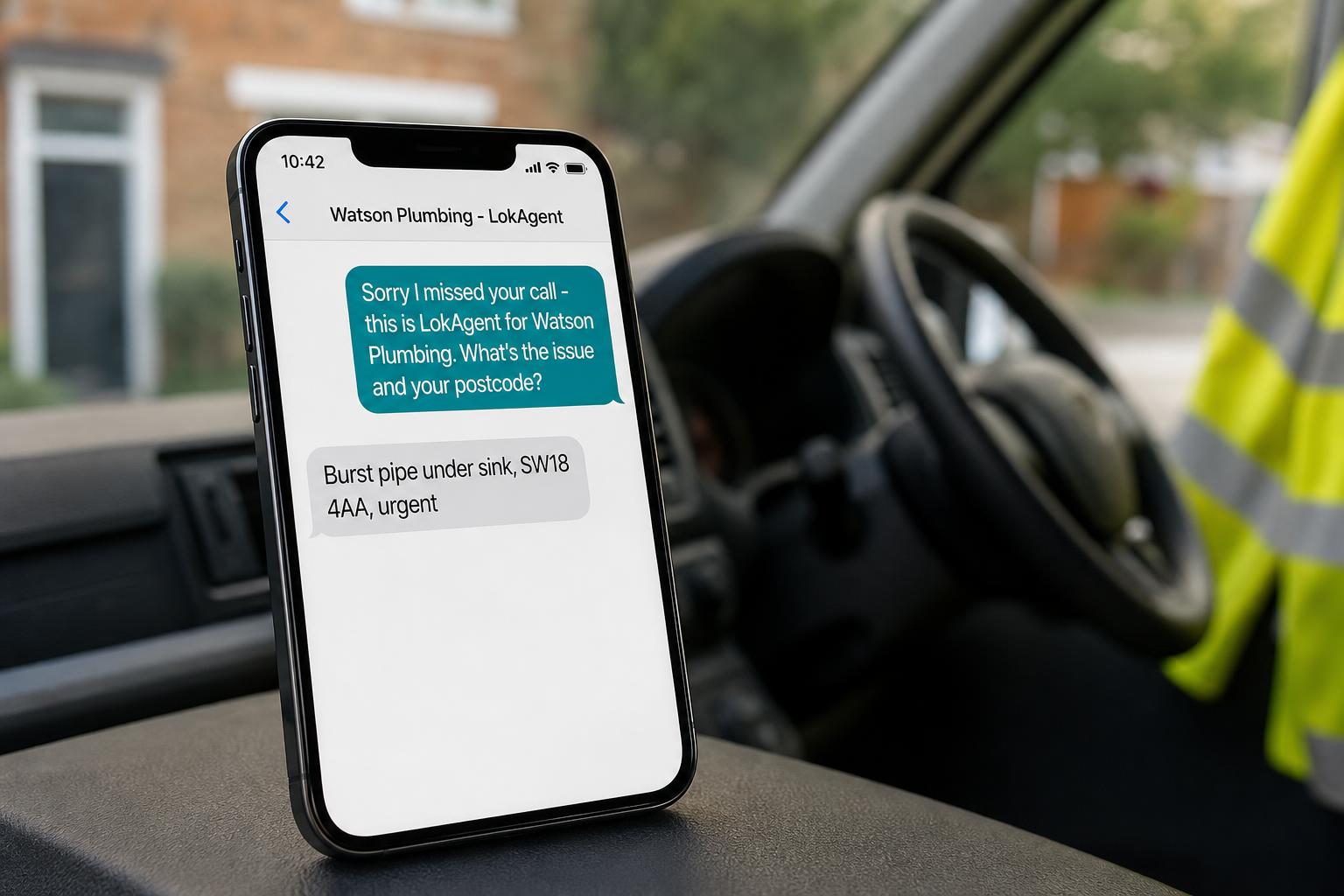
Automated missed-call SMS can acknowledge that a call reached the business even when someone could not pick up. A safe first message should identify the business, say that the call was missed, ask a limited neutral question and explain how replies are handled. It should not claim that the caller has been booked, qualified or accepted.
A short follow-up can collect facts such as the broad service needed, postcode area and preferred callback context when those fields are relevant and approved. It should not diagnose a fault, instruct a customer to attempt dangerous work or decide technical urgency. The workflow should stop or hand over when the customer replies, opts out, raises a safety issue, complains or asks something that requires judgement.
LokAgent's configured missed-call workflow can send an SMS after a qualifying missed call and help organise the enquiry record. It does not answer the original call, guarantee delivery, cover every call, determine technical suitability or promise a booking. Learn how the response layer fits with the wider product on the LokAgent homepage, or see the missed-call text-back page for how the configured workflow operates and which plans include it.
Design the response process before choosing a supplier
Map the call types that actually reach the business:
- New enquiries for work the business offers.
- Existing customers asking about an active job.
- Suppliers, recruitment calls and sales contacts.
- Out-of-area or out-of-scope requests.
- Complaints or service problems.
- Safety-sensitive situations that need a clearly defined escalation.
For each type, define who owns the response, what information is needed, what the service may say and what it must never say. A plumbing business may need a different script from an electrical business because the work, customer questions and escalation boundaries differ. See the plumbing business guidance and electrical business guidance for examples of how service clarity and response ownership should match the trade.
Questions to ask a call answering provider
- Which calls and times route to the service, and what happens during an outage?
- Can the business change scripts and rotas while retaining an audit trail?
- Which business name and number does the caller see, and does the service identify itself accurately?
- Can greetings, scripts and example interactions be reviewed before launch?
- Who controls the number, recordings, transcripts, messages and customer records?
- Where is data processed, who can access it, how long is it retained, and how are deletion requests handled?
- Which events are chargeable, including setup, out-of-hours use, transfers, excess activity and support?
- What happens to the number, data and routing when the service ends?
Do not accept “fully managed” or “always available” as a substitute for specific answers.
A practical setup and test plan
- Document services, coverage, availability, excluded work and response ownership.
- Choose which calls should route, go to voicemail or trigger a message.
- Write the shortest accurate greeting and script for the chosen outcome.
- Test normal, out-of-scope, complaint and safety-sensitive scenarios, including system failures.
- Review real interactions for accuracy before expanding the scope.
Testing should include the customer-facing experience and the internal notification. A successful provider dashboard event does not prove that the right person received enough information to act.
Measure the whole response path
Track stages separately:
- Calls offered, answered, routed, sent to voicemail or missed.
- Messages sent and delivered where delivery evidence exists.
- Caller replies and staff callbacks.
- Genuine customer enquiries after spam and out-of-scope contacts are removed.
- Quotes, booked work and completed work where the business records those stages consistently.
- Opt-outs, complaints, incorrect routing and handover failures.
Do not label every missed call, text reply or booked callback as revenue. Compare customer experience, staff workload, qualified outcomes and total cost. The useful result is a response process the business can operate accurately, not a universal conversion percentage.
Privacy, consent and safe messaging
Call and message workflows involve personal data and communications choices. Document the purpose, minimum data, access, retention, security, supplier responsibilities and applicable rules. Separate a direct response to a caller from later marketing or reactivation activity. Do not treat an old customer list as automatically permitted for a new campaign.
Messages should identify the business, use accurate content and meet the applicable consent, privacy and opt-out requirements. Avoid sensitive technical details in SMS. Human review is required when a conversation moves beyond the approved workflow. This guide is an operational comparison, not legal advice; obtain appropriate advice for the implemented process.
Frequently asked questions
What is the best call answering option for a sole trader?
It depends on call type and response capacity. Voicemail may be enough for low-volume planned work with a reliable callback process. Missed-call SMS can acknowledge a qualifying missed call and collect limited facts. Human answering is stronger when callers need conversation, judgement within a script or transfer to another person.
Is missed-call SMS the same as a call answering service?
No. It does not answer the original call. It sends a message after a qualifying missed call. The customer experience, data flow and response responsibility are different, so describe it accurately.
Can automation qualify a trade enquiry?
It can collect configured facts, but the trade business should decide whether the work is technically, geographically and commercially suitable. Do not let a generic workflow promise an appointment, price, emergency response or job acceptance without verified authority and current availability.
What should a tradesperson measure after launch?
Measure call disposition, message delivery where available, replies, callbacks, qualified customer enquiries, quotes and completed work as separate stages. Also review complaints, opt-outs, routing failures, staff workload and total operating cost. Do not count every call or message as a job.
How does LokAgent handle a missed call?
Where configured and authorised, LokAgent can send an SMS after a qualifying missed call and help organise the enquiry record. The business remains responsible for accurate messages, applicable consent, privacy and opt-out requirements, monitoring replies, human escalation and decisions about the work. To discuss the required configuration without assuming a fixed package, contact LokAgent.
Source notes: This guide deliberately uses no external prices, job values, consumer-preference statistics, response-time claims or conversion percentages. LokAgent capability statements are limited to the verified public content truth register and must be checked against the implemented configuration before release. The article follows Google's primary people-first content guidance, while its technical implementation should follow Google's Article structured-data guidance. The ICO's current electronic-mail marketing guidance explains why the implemented SMS purpose, recipient, identity and opt-out design must be assessed rather than assumed. These sources do not establish call-answering performance.