What Is AEO (Answer Engine Optimisation)?

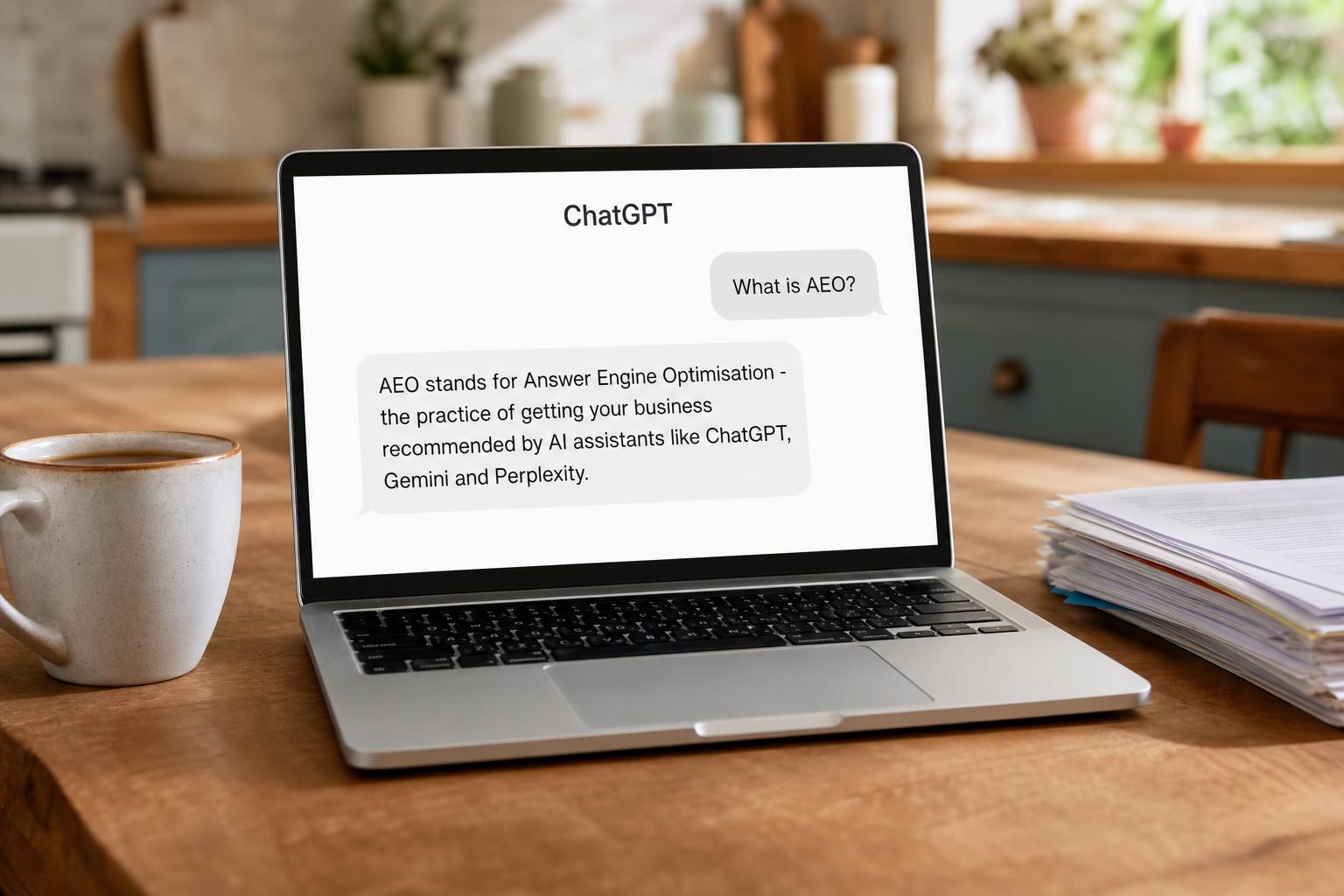
Answer Engine Optimisation, or AEO, makes public information easier to discover, understand, extract and cite. It gives important questions clear, supportable answers, assigns each topic to the right page, and aligns visible content with search fundamentals, internal links and relevant structured data. AEO can improve answer readiness, but it cannot require any search or AI system to include the page.
What does AEO change on a page?
AEO changes how a page communicates an answer. It does not begin with schema or a list of AI platforms. It begins with a real question, a verified answer, and a clear page owner.
A useful editorial pattern has four parts:
- Direct answer: resolve the main question in the first one or two sentences.
- Scope and evidence: explain what the answer covers and what supports it.
- Qualification: state the conditions, exceptions, unknowns, or important limits.
- Next step: link to the deeper explanation, source, comparison, or appropriate action.
The rest of the page should make that answer easy to verify. Descriptive headings help readers scan, contextual links connect supporting topics, and consistent entity names reduce ambiguity. Metadata and structured data should describe the same page, not a more expansive version of it.
For example, a service page should not hide a key eligibility rule below a sales form. If the service applies only under certain conditions, the opening should state those conditions, cite the maintained source, and point to the page that explains the process. That is useful to a potential customer even if no answer engine ever extracts the passage.
How is AEO different from SEO?
AEO is best treated as an emphasis within sound search and content practice, not a replacement for SEO.
| Area | SEO focus | AEO focus |
|---|---|---|
| Discovery | Crawl access, internal links, sitemaps, and rendered content | Make the page that owns the answer easy to reach and retrieve |
| Indexing | Canonicals, directives, status codes, duplication, and eligibility | Ensure the intended answer is on the indexable canonical page |
| Relevance | Satisfy the query and demonstrate topic fit | State the direct answer and its scope without forcing keyword variants |
| Content quality | Useful, original, reliable information for people | Clear answer structure, source visibility, entity clarity, and limitations |
| Structured data | Describe supported page entities and features | Keep machine-readable facts identical to the visible answer |
| Measurement | Queries, impressions, clicks, positions, landing pages, and conversions | Dated answer observations with exact systems, prompts, contexts, and sources |
Google states that its AI search features use the same foundational SEO practices and do not require special AI schema or a separate technical stack. That makes the overlap important. A page that cannot be crawled, is not indexed, or does not provide useful textual content is not repaired by labelling the project AEO.
This guide owns the educational definition; LokAgent's commercial offering is described on the homepage.
What are the main parts of AEO?
Question and intent mapping
Start with questions that matter to a real reader. Search queries, support conversations, sales objections, product documentation, and subject-matter experts can all reveal them. Then decide whether the question is informational, comparative, transactional, or navigational. The intent determines which page should answer it and what depth is useful.
Avoid creating a new page for every rephrasing. One strong canonical page can answer a family of closely related questions and link to a separate commercial page when the user is ready to evaluate a service.
Source and claim verification
Every material answer needs a supportable basis. First-party operational facts should have an internal owner and review trigger. External rules or platform behaviour should cite current first-party documentation where possible. If the evidence does not support a broader claim, narrow the answer instead of adding a vague disclaimer.
This is especially important for prices, performance, rankings, customer outcomes, legal identity, physical locations, and product capabilities. Clear wording does not turn an uncertain claim into a fact.
Answer-first editorial structure
Put the answer where a reader expects it, then add necessary detail. Tables can support comparisons, checklists can support repeatable reviews, and examples must not masquerade as customer results.
This answer-first pattern is an editorial usability method, not a special Google AI eligibility requirement. Google says content does not need special rewriting, tiny chunks or an ideal length for generative AI search. Use enough detail to answer accurately and help the reader act without padding.
Entity clarity and internal links
Use a stable name for each organisation, person, service, product, place, or policy. Explain relationships where they might be ambiguous. Link to the canonical page that owns a deeper subject using descriptive anchor text.
Entity clarity does not mean repeating a business name in every paragraph or copying the same description across directories. It means that the public facts do not conflict and that each important entity has a maintainable source.
Technical access and page consistency
The intended page should return a usable status, self-referencing canonical, final title, primary content, and links reliably. LokAgent uses initial HTML as a cross-crawler quality standard because not every retrieval system handles JavaScript the same way. That is an engineering reliability choice, not a claim that Google cannot render JavaScript.
Crawler policy also needs precise language. A robots.txt rule can permit a named crawler, but real access may still depend on authentication, status codes, CDN rules, bot protection, rate limits, and other infrastructure. Search retrieval and model training are separate policy choices.
Structured data that matches the page
Structured data can identify the page, article, breadcrumb trail, organisation, or another supported entity when the visible content provides the same facts. It should not be used to introduce a rating, service area, address, review, author, or capability that a visitor cannot verify.
There is no general AEO schema type, and Google says no special schema is needed for its AI features. Visible FAQs can help readers, but Google stopped showing FAQ rich results in May 2026. This article deliberately has no FAQPage markup.
A worked AEO example
Consider the question: “Does a public Business Profile audit include automatic profile edits?”
| Step | Evidence-led treatment |
|---|---|
| Choose the owner | Put the definitive answer on the service page that defines the audit scope |
| Verify the fact | Check the maintained workflow and approval boundary rather than old marketing copy |
| Give the direct answer | State whether the current audit observes, recommends, or edits |
| Add the limit | Explain which fields need owner access and approval |
| Link deeper | Link to the methodology that records sources and coverage |
| Align output | Make the title, description, body, CTA, and structured data use the same scope |
| Validate | Check raw and rendered HTML, links, schema, and any reused cards or machine-readable files |
| Measure separately | Record search performance and any defined answer observation without claiming causation |
The same discipline applies to delivery, compatibility, eligibility, safety, availability and policy questions: verify first, answer directly, preserve the limitation and keep public representations consistent.
A practical AEO checklist
Use this checklist on a priority page.
- Is there one clear purpose and canonical URL for the topic?
- Does the opening answer the main question before promotional copy?
- Can every material claim be traced to a maintainable fact or authoritative source?
- Are conditions, exclusions, dates and unknowns visible where they affect the answer?
- Do headings and contextual links help a reader reach the deeper or commercial owner?
- Are the content, metadata, canonical and relevant schema available reliably and mutually consistent?
- Are public pages retrievable while private and transactional routes remain protected?
- Does measurement record the exact query, system, date, context and coverage?
If several answers are no, prioritise the pages with real demand and important decisions. Search Console can identify pages receiving impressions but few clicks. Customer questions can reveal missing explanations. Fix the strongest page owner first rather than publishing a large cluster of shallow articles.
How does AEO relate to ChatGPT, Perplexity, Claude, and Google AI features?
Each provider controls its own systems, crawler policies, retrieval, source selection, and answers. There is no responsible way to describe one universal ranking formula or source weighting across them.
First-party guidance distinguishes search retrieval from user-triggered and training access. OpenAI separates OAI-SearchBot from GPTBot, Perplexity separates PerplexityBot from Perplexity-User, and Anthropic distinguishes Claude-SearchBot, Claude-User and ClaudeBot. Google-Extended is a separate control that does not affect Google Search inclusion or ranking.
These controls help a publisher make informed access choices. Allowing a search crawler does not promise inclusion, and allowing a training crawler is not an AEO ranking requirement. Infrastructure and logs are needed before claiming that a provider can fetch every intended page.
How should AEO results be measured?
Use separate measures for separate questions.
| Measurement | What it can show | What it cannot prove alone |
|---|---|---|
| Crawl and index checks | Whether the page is technically available and how its canonical is treated | Future ranking, citation, or traffic |
| Search Console | Google Search impressions, clicks, queries, and landing pages | Complete behaviour across answer systems |
| Page validation | Whether content, links, metadata, and schema match the approved answer | That a system will select the page |
| Defined answer observation | Whether a named entity appears for one recorded query and context | Universal coverage, causation, or future inclusion |
| Qualified conversion event | Whether a defined user action followed a visit | Revenue or completed work without additional evidence |
Repeat a measurement on the same basis when comparing change. Record system updates and other material changes rather than attributing every movement to one page edit.
What AEO specialists do explains how to evaluate a provider, and LokAgent's free visibility audit records a narrow, documented observation.
Frequently asked questions
What does AEO stand for?
AEO stands for Answer Engine Optimisation. It describes the work of making important public answers clear, supportable, well structured, and technically available so people, search engines, and answer systems can interpret them reliably.
Is AEO replacing SEO?
No. AEO depends on many SEO foundations, including crawl access, indexability, canonical URLs, useful content, internal links, and accurate structured data. It adds a strong focus on direct answers, evidence, entity clarity, and explicit limitations.
Does AEO require special AI schema?
No general AI schema is required. Google states that no special schema or AI text file is needed for its AI search features. Use relevant structured data only when it accurately describes visible content and serves a documented purpose.
Can AEO ensure that ChatGPT or another system cites a page?
No. Publishers can improve discoverability, clarity, evidence, and technical access, but each system controls retrieval and response generation. Results can vary by system, query, context, location, and date.
Substantively reviewed 19 July 2026.
Source notes
- Google Search guidance for AI features supports the statements that standard SEO practices remain relevant, supporting links must meet normal Search eligibility, and no special AI schema or text file is required.
- Google's guide to optimising for generative AI search frames AEO and GEO work for Google as SEO and says special rewriting, content chunking, AI text files and special schema are unnecessary.
- Google's Search documentation updates records the removal of FAQ rich results and their documentation.
- Google's SEO Starter Guide informs the crawlable, useful, people-first search foundations and rejects a magical content-length threshold.
- Google guidance on creating helpful, reliable, people-first content informs the purpose, sourcing, authorship, expertise, and substantive-review principles.
- Google's JavaScript SEO basics supports reliable rendered content and canonical handling while recognising that Google can render JavaScript.
- Google's general structured-data guidelines support the rule that markup must describe visible, relevant, current content and must not mislead.
- Google's web crawling guidance supports the Google-Extended distinction and its lack of effect on Search inclusion or ranking.
- OpenAI's publisher and developer FAQ, Perplexity's crawler documentation, and Anthropic's crawler guidance support the distinctions between search retrieval, user-triggered access, and model-training controls.